Explora Journeys sells around 460 suites on Explora I, and every single one is oceanfront with a private terrace. There are no inside cabins. No interior category exists on the ship at all. The windowless interior cabin is the oldest revenue trick in the business, and Explora deleted it on purpose. This post is about why that is a real naval-architecture decision and not just a brochure line, what it costs the ship, and what it buys you as a guest.
I have sailed Explora I across several Mediterranean and Greek voyages, embarking out of Venice. My own suite was oceanfront with a terrace, like everyone else’s. So I am writing this from both sides: the operator and mariner who understands why a ship gets built this way, and the guest who woke up to the water for a week straight.
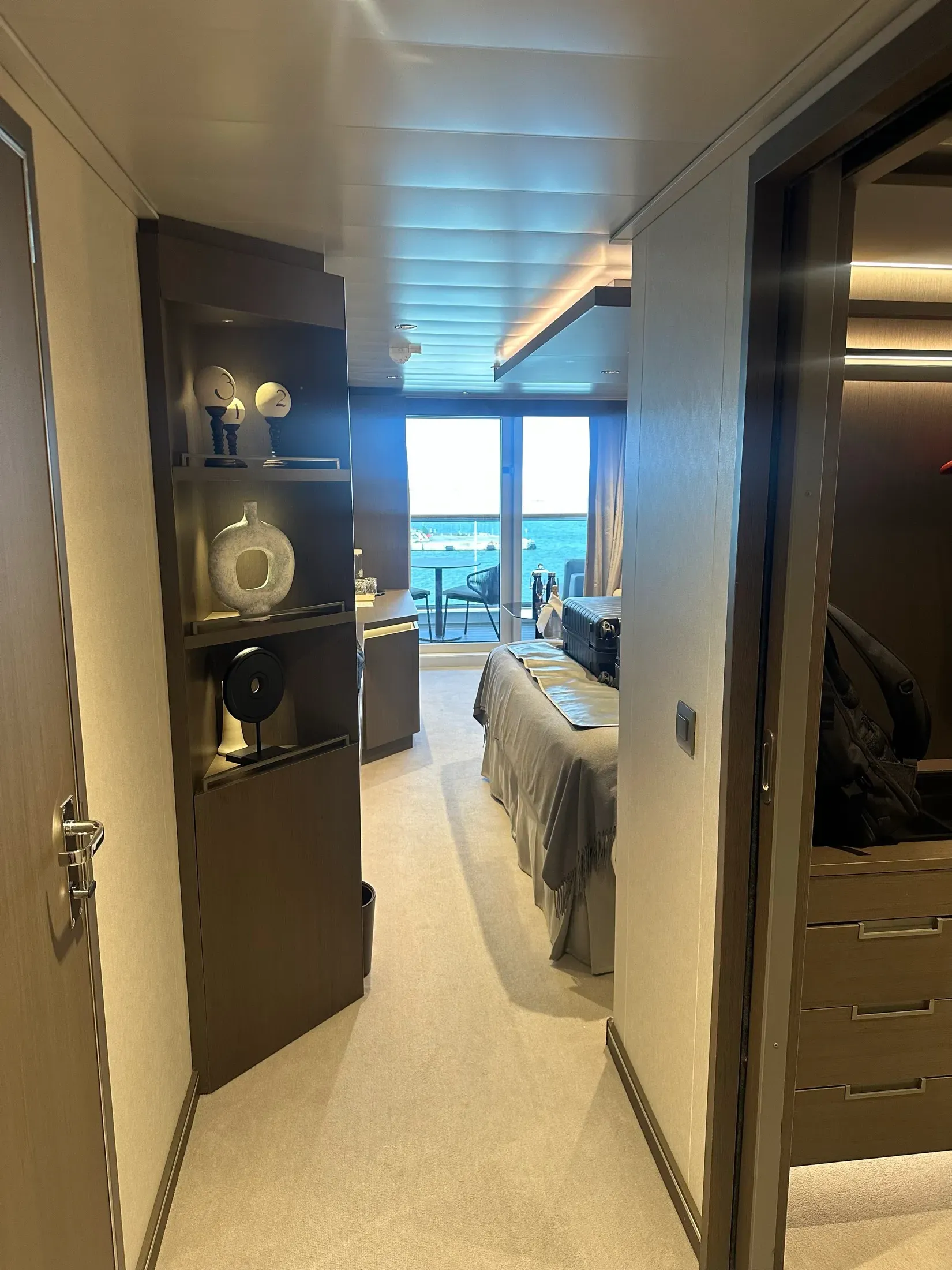
Does Explora Journeys have any inside cabins?
No. There is no interior or windowless category on the ship at any price.
On a conventional cruise ship, accommodation is sorted into a price ladder by where it sits in the hull. Interior cabins are the cheapest, buried in the core of the ship with no window. Then oceanview cabins on the perimeter. Then balconies. Then suites up top. The interior cabin exists because it is cheap to build and easy to fill, and on a big mainstream ship it can be a third or more of the rooms.
Explora has none of that. Every category, from the entry Ocean Suites up through the Ocean Penthouses, the Ocean Residences, and the four-figure-square-foot Owner’s Residence, has floor-to-ceiling windows and a private terrace. Explora’s own language for the layout is “designed to feel like your own private yacht.” That is their marketing phrase, so read it as a claim rather than a measurement, but the structural fact under it is true: there is no part of this ship where you can book a room and not see the ocean.
The entry suite is 377 square feet including a private terrace. That is the smallest room on the ship, and on a lot of luxury lines it is a mid-tier number. If you want to put the categories side by side, the suite picker sorts them by size and price.
Why would a ship designer resist building it this way?
Here is my read as someone who has spent a life on the water and runs hospitality for a living. Take this as an informed operator’s interpretation, not a documented engineering memo from the shipyard.
If you tell a naval architect that every guest room must touch the hull and have a terrace, you have just made the architect’s job harder and the owner’s revenue thinner. Every revenue room now has to sit on the perimeter of the vessel, wrapped around the outside. You cannot stack cheap windowless boxes in the middle of the ship to pad the count. So your total berth number for a given size of hull drops, sometimes a lot. Everything that does not need a view, the galleys, the laundry, the stores, the engineering spaces, the crew quarters, gets pushed inward and downward to make room. Public rooms compete for the same scarce perimeter the suites want.
That is the cost. Fewer rooms per ton of steel, and a more constrained internal layout. A conventional owner looks at that and adds interior cabins, because empty hull volume that earns nothing is a sin in this business.
Explora did the opposite. And the cost it accepted is exactly what produces the thing you feel as a guest. What that all-suite product actually includes is laid out on the inclusions page.
What does all-oceanfront actually buy you?
Space. The cleanest way to prove that is a number called the space ratio: gross tonnage divided by guest count. It is a rough measure of how much ship there is per person.
Explora I is around 63,900 gross tons (Explora reports figures in the low 60,000s) and carries 922 guests at double occupancy. That works out to around 69 gross tons per guest, which is among the highest in the luxury ocean category. I have seen competitor ratios floated in the high 60s and mid 70s, but those come from aggregator math rather than each line’s primary documents, so I won’t rank it. What I will tell you is that around 69 is a genuinely high number, and the reason it is high is precisely the all-oceanfront choice. A low berth count for a hull in the low 60,000-ton range is the mathematical shadow of refusing to build interior cabins.
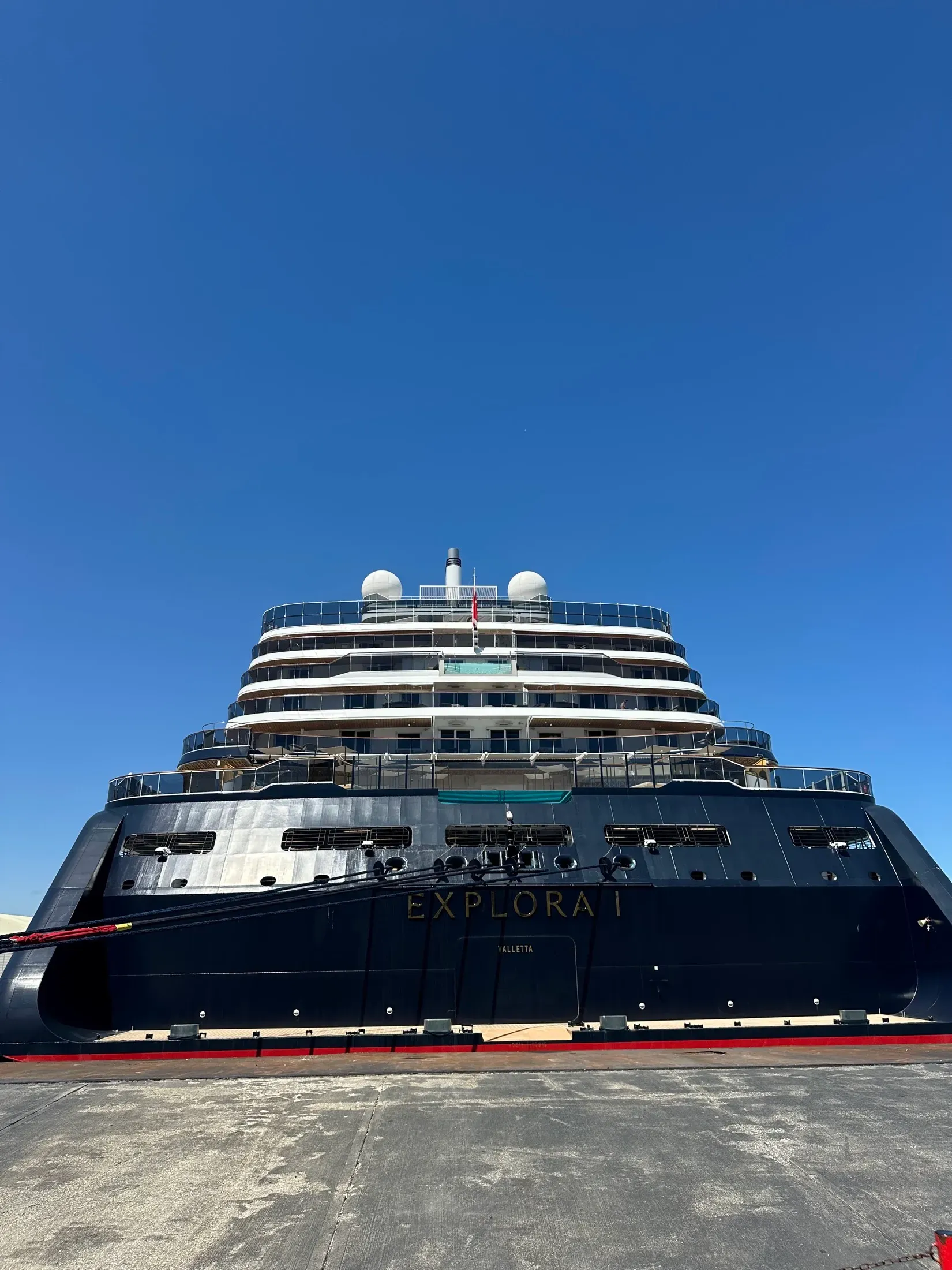
The second number that falls out of the same decision is the crew ratio. Explora cites guest-to-staff of about 1.25 to 1, roughly five crew for every four guests. When you do not cram the hull with cheap rooms, you do not cram it with cheap-room guests either, and the service math stays generous. On my voyages that showed up as the thing you cannot quite point to: someone always seemed to be a half-step ahead of what I was about to ask for.
So the trade reads like this. Explora gave up berth count and layout flexibility. It bought space per guest and a service ratio that most ships its size cannot run.
How big is the gap from the smallest suite to the largest?
Wide. The entry Ocean Suite is 35 to 39 square meters, that 377 to roughly 420 square feet I mentioned. The Ocean Penthouses run 43 to 69 square meters, around 463 to 743 square feet. The Ocean Residences climb to 65 to 149 square meters, roughly 700 to 1,604 square feet. And the Owner’s Residence at the top is about 280 square meters all in, near 3,014 square feet, split roughly half indoor and half terrace.
That is an entry-to-top span of about eight to one. But here is the part that matters for most people reading this: the floor is high. Because there is no interior cabin to anchor the bottom of the range, the cheapest thing you can book is a 377-square-foot oceanfront suite with a terrace. The bottom rung of this ladder is where a lot of ships put their middle.
If you want help sorting which of those categories is actually worth the jump in price, I wrote a separate piece on which Explora suite to book, and you can put the categories side by side on the suite comparison page.
What does it feel like to have no inside cabin as an option?
This is the part I can only tell you first-hand, and it is the part the spec sheet cannot.
I know windowless interior cabins. Most of the industry has them, and I have stayed in plenty over the years. The interior cabin is a place you sleep and then leave, because the room itself gives you nothing. There is no time of day in it. You wake up and you have no idea whether the sun is up.
An all-glass suite that runs to the water does the opposite, and it does it more the longer you sail. The light changes the room through the day. The terrace stops being a feature and becomes a second room you actually use. On Explora I, breakfast arrived on my terrace before I had fully worked out how to ask for it, and after that it was just where the morning happened. Coffee outside, the wake going by, the light off the water. By day three you stop registering it as luxury and start registering it as how mornings are supposed to go.
That is the quiet argument for the whole design. When every room is a good room, the ship does not have to spend your attention managing the gap between the cheap rooms and the expensive ones. There is no cheap room.
Who builds these ships, and are they LNG?
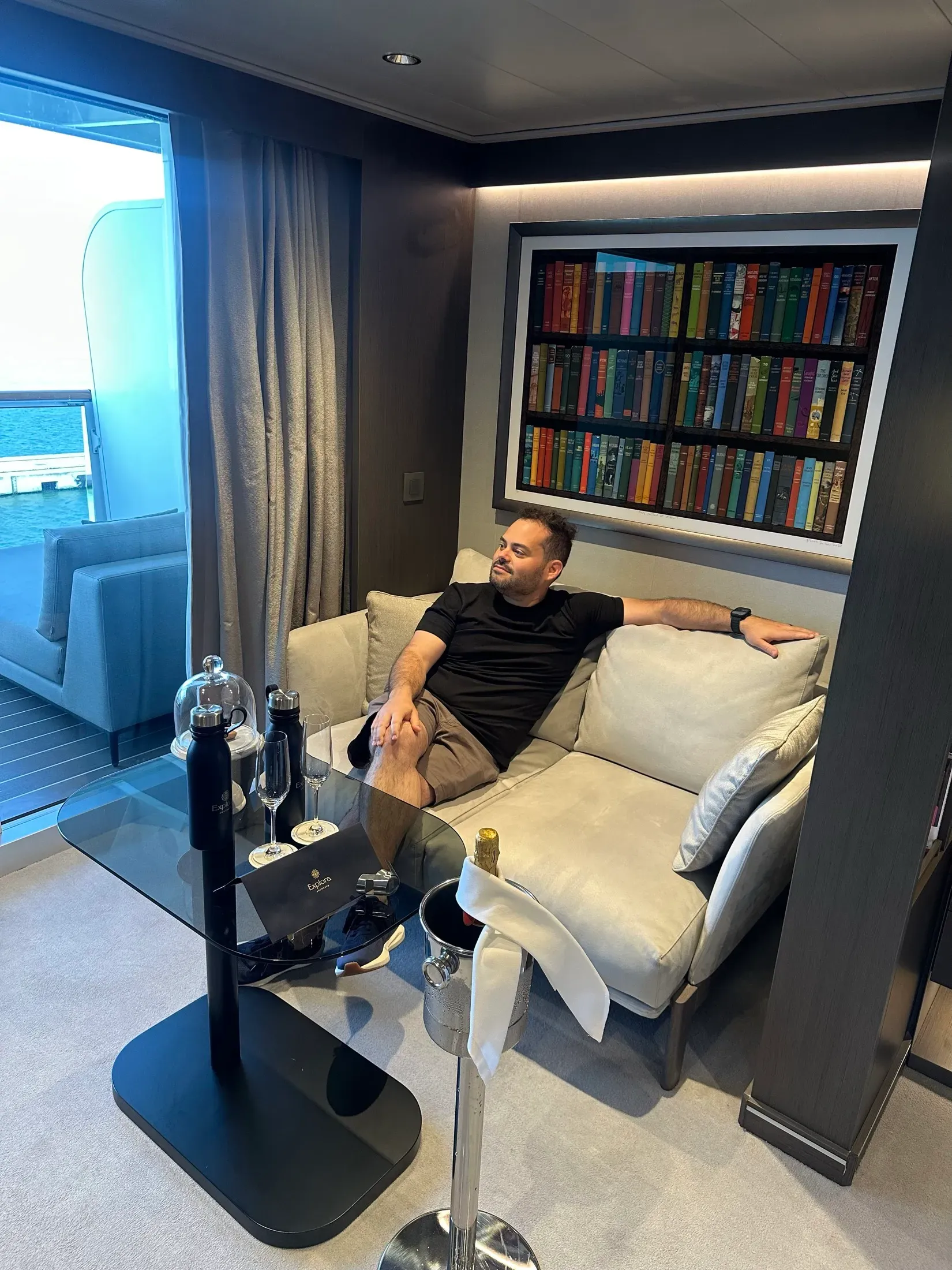
The Explora hulls are built by Fincantieri at its Monfalcone shipyard near Trieste, Italy. Not at a Vard yard. Vard is a Norwegian builder that Fincantieri owns a majority of, and you will see it cited, but the Explora ships came out of Monfalcone. I could not verify a named external naval architect beyond the Fincantieri yard, so I won’t credit one.
On propulsion: Explora I runs on conventional marine diesel, four Wärtsilä generators producing around 38 megawatts, driving the ship electrically. It is not an LNG vessel. The later hulls are a different story, Explora III and IV are built for liquefied natural gas, so if you read “Explora is LNG” somewhere, it is true of the newer ships and not of the one I sailed. If propulsion and environmental systems matter to your decision, ask me directly and I will tell you what is documented and what is marketing. You can read the spec lines for each hull on the ship comparison page.
The ship is 248 meters long, about 814 feet, with a beam of 32 meters and somewhere around 13 to 14 decks depending on how you count the technical and crew levels. None of that is the headline. The headline is the choice to put every guest on the outside of the hull.
Is the all-oceanfront design worth paying for?
For the right traveler, almost always. If you have a habit of booking the cheapest room and treating it as a closet, the math changes here, because the cheapest room is a 377-square-foot oceanfront suite and you will use it. If you are coming off a land-luxury habit, an Aman or a Four Seasons, the all-suite, all-view layout is a big part of why this ship reads to you the way a hotel does and most cruise ships do not.
Where I would slow you down: if your trip is mostly about being off the ship in port all day, you are paying for a room you will barely sit in, and a different value calculation applies. I get into that trade-off and the rest of the honest ledger in is Explora Journeys worth it, and you can read the structure of the ship herself on the Explora I page.
Send me your dates and the suite tier you are considering and I will have live pricing in your inbox within 24 hours, no call required. If a different line fits your trip better, I will tell you that too.
Questions people ask
Does Explora Journeys really have no inside cabins? Correct. Every accommodation on the ship is a suite, and every suite is oceanfront with floor-to-ceiling windows and a private terrace. There is no interior or windowless category at any price. Explora I has around 460 suites, all of them on the perimeter of the hull. This is the central design decision of the line, not a feature of a few high-end rooms.
How small is the smallest Explora suite? The entry Ocean Suite is 35 to 39 square meters, about 377 to 420 square feet including a private terrace. That is the floor of the entire ship. On many luxury cruise lines a room that size sits in the middle of the range rather than at the bottom, which is the practical upside of a ship that refused to build anything smaller.
What is Explora’s space-per-guest ratio? Explora I is around 63,900 gross tons and carries 922 guests at double occupancy, which works out to around 69 gross tons per guest. That is among the highest in the luxury ocean category. The number is high precisely because the all-oceanfront design caps how many rooms fit in the hull, so each guest gets more ship.
Who builds the Explora ships? Fincantieri, at its Monfalcone shipyard near Trieste, Italy. You will sometimes see Vard credited, since Fincantieri owns a majority of the Norwegian builder Vard, but the Explora hulls were built at Monfalcone. I was not able to verify a named external naval architect beyond the shipyard itself.
Are the Explora ships LNG-powered? Explora I is not. It runs conventional marine diesel, four Wärtsilä generators producing around 38 megawatts, driving the ship electrically. The newer hulls are different: Explora III and IV are built for liquefied natural gas. So if a summary calls the line “LNG,” that is accurate for the later ships and not for the one I sailed. If propulsion and environmental systems factor into your decision, ask me and I will separate what is documented from what is marketing.
How much bigger is the top suite than the entry suite? About eight times. The entry Ocean Suite is around 377 square feet; the Owner’s Residence at the top is roughly 3,014 square feet all in, split about half indoor and half terrace. The Penthouses and Residences fill the range in between. Even so, the entry suite is large by cruise standards because there is no cheaper, smaller category beneath it.
— Justin