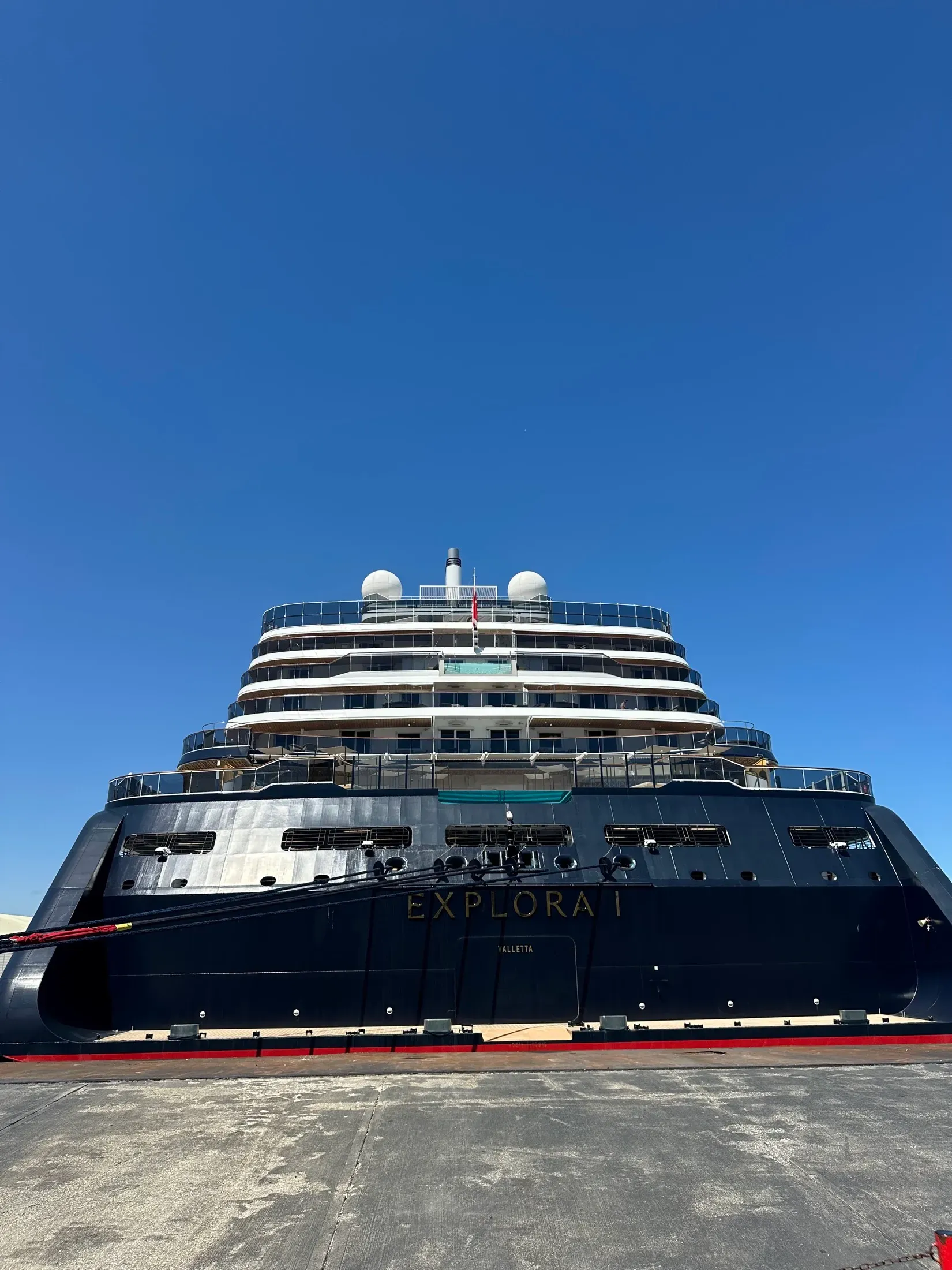
Explora I is a 248-meter, roughly 64,000-gross-ton hull, which is large for the luxury tier, and that size is most of why she rides steadier than the yachts I grew up on. Ships this size carry retractable fin stabilizers, paired fins below the waterline that swing out to cut the side-to-side roll, and a long, large hull simply does not react to every wave the way a 40-footer does. So the honest answer to the motion question: much smoother than people fear, on most itineraries. You still feel genuine weather, and where your suite sits on the ship is the one lever you actually control.
I have spent a life on the water, sailing, diving, time at the helm, long before I ever booked anyone a Journey. That is the lens here. A lot of what gets written about cruise-ship motion is either marketing (“you’ll never feel a thing”) or forum panic (“the whole ship was shaking”). The truth sits in between and it is mostly physics, so let me walk it the way I would read any hull: size first, then stabilizers, then the part you can do something about.
How big is Explora I, and why does size smooth the ride?
Size is the foundation, and Explora I has it. Per Fincantieri’s own spec sheet, she is 63,621 gross tons, 248 meters long overall (about 815 feet), 32.6 meters at the beam (about 107 feet), with a design draught of 6.9 meters, roughly 7 meters of hull under the water. Fourteen decks. Service speed 18 knots. The full deck-by-deck layout sits on her ship page. Gross tonnage, for the record, is a measure of enclosed volume, not weight, but it tracks closely with how much ship there is, and ~64,000 GT is genuinely large for this tier.
Here is why that matters for the ride, in plain terms. A hull rides through waves as a function of its size and its waterline length. A long, large ship has so much inertia, so much resistance to being shoved around, that a short, choppy wave train barely moves it. The wave passes under the hull faster than the hull can react, so the deck stays close to level. A small boat is the opposite: light, short, and quick to lift and drop with every swell that comes along. I have spent enough hours on a 40-foot sailboat heeling to every gust to feel that difference in my body. Step from that onto 248 meters of stabilized ship and the sea has to work much harder to move you.
That is the single most underrated reason a big luxury ship rides better than a small yacht, and it is the reason I tell nervous first-timers not to chase the most intimate ship they can find if motion is their worry. Intimacy and a smooth ride pull in opposite directions. Explora sits on the large end of luxury, and your inner ear notices.
Does Explora have stabilizers, and what do they actually do?
Yes, and here is where I am going to be precise, because this is exactly the kind of spec people overstate.
Ships of Explora I’s size and class carry retractable fin stabilizers. It’s a pair of stubby wings, one per side, mounted below the waterline near mid-ship. Underway, they swing out and angle into the flow of water; sensors read the ship starting to roll, and the fins tilt to generate an opposing lift force that pushes back against it. When the ship is in port or in calm water, they retract into the hull. They are the single biggest reason a modern ship rolls so much less than older vessels did.
One honest caveat I owe you. Explora does not publish the specific stabilizer system on Explora I by name in any source I could find, so I am describing the mechanism as the class norm and reading the ship’s behavior as a mariner, not quoting it from Explora’s literature. The ride is entirely consistent with active fin stabilizers, and a ship of this size and recency would be an outlier not to have them. But I will not invent a fin count or a manufacturer for you, and if a specific number ever matters to your booking, I will confirm it rather than guess.
What they do is cut roll, the side-to-side rocking, and they do it dramatically: fin stabilizers can reduce roll by up to roughly 80 to 90 percent. That is a general maritime figure, not an Explora-published number, so take it as the order of magnitude, not a promise about your sailing. What stabilizers do not do much for is pitch, the bow rising and falling as the ship meets a head sea. That is the motion length helps with, and at 248 meters Explora I has length on her side. So the picture is: stabilizers handle the roll, the hull’s length handles the pitch, and the two together are why a head sea on a ship this size feels like a long, slow rise rather than a small boat slapping into every wave.
A small propulsion note, since people conflate it with ride. Explora I runs on ABB Azipod pods, electric propulsion units mounted outside the hull that rotate to steer, and ABB states the design reduces vibration and noise. That is about how quiet and smooth-feeling the ship is underway, the absence of engine buzz through the floor, not about roll. Worth knowing, but do not mistake it for a stabilizer. They solve different problems.
So will I actually feel the ship move?
Sometimes, yes, and I would rather tell you that now than have you discover it on night two.
Here is the honest ledger from real Explora I sailings, mine and other guests’. On a calm coastal route, you can go a whole evening and forget you are on the water at all. My own voyages were the Mediterranean and the Greek isles, embarked from Venice, and they rode steady. Then there is the other end: some guests have reported strong in-cabin motion in genuinely rough seas, shaking, creaking, a roll you feel in bed, particularly high up and toward the bow or stern. And other guests have crossed rough water on the same ship and called her stable and sure-footed. All of that is true at once, and none of it is a contradiction.
The synthesis is the part worth internalizing. Explora I is stable for her class. The stabilizers cut the roll, the size cuts the chop, and on a normal coastal itinerary most people feel very little. But no ship, at any price, erases the ocean. A genuine gale in open water will be felt on any vessel afloat, and the larger and longer the ship, the gentler that feeling, but never zero. Anyone who promises you a flat ride in any weather is selling, not advising.
The two variables that actually move your odds are the route and the suite. The route, you choose when you pick the itinerary. The suite, you choose when you book. Both are levers I can help you pull, and if motion worries you, the suite picker is a good place to start narrowing.
Where on the ship is the ride smoothest?
This is the practical payoff, and it is the same on every ship ever built: low and mid-ship.
Motion is felt least near the ship’s center of gravity, which sits low in the hull and amidships, roughly the middle of the ship fore-to-aft. Think of the ship as a seesaw. The middle barely moves; the ends swing. And think of it as a metronome: the higher up you are, the more arc you travel as the ship rolls. So the calmest spot is a lower deck, in the middle of the ship. The liveliest is a high suite right at the bow or the stern. That is not Explora-specific, it is geometry, and it holds for every passenger ship.
The good news on Explora is that the spread is gentle, because she is large and stabilized, so even a high, end-of-ship suite is far from rough on a normal route. But if motion is a real concern for you, the choice is clear. Cruise Critic’s review makes the same call I do, pointing motion-sensitive guests specifically to a lower-deck, mid-ship Ocean Terrace suite on Deck 6, and one guest who booked exactly that, an Ocean Terrace on Deck 6, reported it rode calm and steady while higher suites toward the ends felt livelier. That tracks with everything I know about reading a ship.
So if you tend toward seasickness, here is my counsel, plainly: pick the middle of the ship, lower rather than higher, over a fancier suite at either end or up top. Every Explora suite is oceanfront with a terrace, which is its own small motion advantage, since a horizon to look at genuinely settles the inner ear in a way an interior cabin never can. The full suite-by-suite math, including where the value sits and which categories I think are oversold for their tier, lives in the 14-suite breakdown. For motion specifically, the rule is simpler than the price chart: low and central wins.

How does it compare to a yacht or a small ship?
This is the contrast I feel most directly, because I came to ships from sailing, and the difference is night and day.
On a sailboat, you live with the motion. The boat heels to the wind, every swell lifts and drops you, and you brace, lean, and time your steps to the deck. That is most of the appeal when sailing is the point. It is exactly the wrong thing when a calm dinner and a steady night’s sleep are the point. A small motor yacht is better than a sailboat but still light enough to move with the sea in a way you feel constantly.
On Explora I, the deck mostly stays where you left it. You walk a long corridor without the floor tilting under you. You set a glass down at dinner and it stays put. That is the whole trade of a big stabilized ship: you give up the intimacy and the direct connection to the water that a yacht gives you, and you get a deck that behaves like a floor. For the hotel-luxury traveler who wrote off cruising, that is usually the right trade, and it is a big part of what changes their minds. If you want the full version of that argument, my honest verdict on whether Explora is worth it puts the ride in the context of everything else. Families weighing it for kids who get queasy can read how it went with mine.
One last first-hand note, because it is the kind of thing only the water teaches you. The calmest hour I had aboard was the aft lounge at dusk, watching the wake unspool dead straight behind us, the surface barely creased. A straight, clean wake is a tell: it means the ship is tracking true and steady, not getting knocked around. I have watched a lot of wakes over a lot of years, and Explora I’s, on those Mediterranean evenings, was as composed as I have seen from a ship that size. That is not a spec I can hand you. It is a mariner reading his own eyes, which is the part of this you are actually hiring me for. The rest of those quiet evenings, the lounges and the light, I wrote up separately.
Questions people ask
Does Explora Journeys make you seasick? For most people, much less than they fear. Explora I is a large ship for the luxury tier at roughly 64,000 gross tons of enclosed volume and 248 meters long, and that size plus retractable fin stabilizers damps the side-to-side roll that causes most motion sickness. You still feel real weather, and a rough open-water leg can produce noticeable motion, but a calm coastal route like the Mediterranean rode steady for me. If you are motion-sensitive, a low, mid-ship suite is the single best thing you can do.
Does Explora Journeys have stabilizers? Ships of Explora I’s size and class carry retractable fin stabilizers, paired wing-like fins below the waterline that swing out to cut roll, and the ride is consistent with that. Explora does not publish the specific system by name, so I describe it as the class norm and my read as a mariner rather than a spec I can quote from their literature. Stabilizers cut roll, the side-to-side motion; they do little for pitch, the bow rising and falling, which is where a ship’s length helps instead.
How big is Explora I, and does size help the ride? Explora I is about 63,621 gross tons, 248 meters long, and 32.6 meters at the beam, per Fincantieri’s own spec sheet. Size helps the ride directly: a long, large hull has too much inertia and too long a waterline to react to every short wave the way a small boat does, so it rides through chop instead of bobbing on it. That is the core reason a big luxury ship feels steadier than a yacht.
Which Explora suite is best if I get seasick? Low and mid-ship. Motion is least felt near the ship’s center of gravity, which sits low and amidships, and most felt high up and toward the bow or stern. Cruise Critic’s review specifically points motion-sensitive guests to a lower-deck, mid-ship Ocean Terrace suite on Deck 6, and that matches my own counsel: pick the middle of the ship, lower rather than higher, over a high suite at either end.
Will I feel the ship move in rough seas on Explora? Yes, in genuinely rough seas you will, and anyone who tells you otherwise is selling something. Some Explora guests have reported strong in-cabin motion in heavy weather, particularly high up and toward the ends of the ship, while others crossed rough water and found her stable. Both are true: she is stable for her class, stabilizers cut the roll, but no ship erases the ocean. Route and suite placement are what move the odds in your favor.
Is Explora a good choice for a nervous or first-time cruiser worried about motion? For a calm-water itinerary, yes, it is one of the easier luxury ships to start on. She is large enough to ride steadily, the suites are all oceanfront so you have a horizon to look at, which genuinely helps, and a low mid-ship suite stacks the deck further in your favor. If your itinerary includes a long open-ocean crossing or a high-latitude leg, tell me before you book, because the route matters more than the ship, and I will be honest about what to expect.
If motion is the thing standing between you and booking, send me your dates and the suite tier you’re considering. I’ll have live pricing in your inbox within 24 hours, no call required.
— Justin